Porsche’s Maximisation Of Efficiency, The Taycan’s Energy Recuperation Braking

Ever wondered how the Porsche Taycan generates new energy while driving, well, it does so when braking and this is possible with a unique recuperation management system.
First off, vehicles with an internal combustion engine convert kinetic energy into heat when the brakes are applied, which they’re unable to use.
Electric vehicles, on the other hand, can recover a large portion of this energy, using the electric machines as generators when slowing down and store the power generated in the battery.
For example, the Porsche Taycan can use a significant amount of the braking energy for propulsion, which is referred to as recuperation.
Moreover, kinetic braking energy increases twice as fast as speed, double the speed means four times the recuperation.
As such, when braking from 100 km/h, the Taycan generates four times as much energy as when braking from 50 km/h.
Significantly, this recuperation and the propulsion itself both play a key role in the efficiency of electric vehicles.
Porsche’s head of chassis development in Weissach, Ingo Albers, explained, “We incorporate the electric motors we produce in Zuffenhausen into the brake system for the purpose of energy recovery. Electric motors can generally be controlled in four-quadrant operation.”

In other words, an electric motor can work with both the rotation speed and torque running in the same positive direction.
However, each electric motor can also function as a generator, in which case the motor continues to turn in the same direction, but is now powered by the wheels rather than powering them itself.
It generates electrical energy, instead of consuming it. As it takes a lot to power the motor and thus turn the rotor against the magnetic resistance, this negative torque can be used for braking.
Therefore, the control units and power electronics of the electric motors in the Taycan are intelligently connected with the controls and logics of the brake control system.
Meaning, the conventional hydraulic wheel brake and electric motors can slow down the vehicle together.
The experts in Weissach have developed an intricate recuperation strategy. In milliseconds, the systems choose what percentage of the braking will be electric and what will be hydraulic.
While the driver cannot feel the difference, they can see it in the power meter in the Taycan’s instrument cluster.
“Though, in extreme situations, such as full braking from a top speed in a fully loaded Taycan, a maximum braking capacity of more than two megawatts must be applied. The electric powertrain cannot do that alone. The conventional wheel brake is then applied to a higher degree,” furthered Albers.

Notably, around 90 percent of everyday braking is 100 percent electric, allowing the Taycan to recover energy.
So, the conventional wheel brake may also be activated in such situations because the battery is already full and can no longer recharge through recuperation.
Regardless, thanks to the design of the electric motors and the electronics in conjunction with Porsche’s signature intelligent control, the Taycan can recuperate with up to 290 kW.
Fret not, the Taycan is still at the absolute top of the field according to Albers, as the hydraulic wheel brake is designed for high performance.
Conversely, some automakers have the electric drive’s recuperation system activated automatically the moment the foot is off the gas pedal, which is referred to as one-pedal driving.
Albers concluded, “We made the decision to go a different route with the Taycan. Drivers apply the brakes to slow down, which is a learned behaviour and it’s authentic. The driver receives consistent, predictable feedback. We have incorporated limited recuperation into the gas pedal, which the driver perceives to be efficient, smooth coasting particularly in rural areas. We also offer full integration of systems such as ABS and PSM.”
Always with the goal of maximum efficiency, the Taycan secures around one-third of its range with the recovery of brake energy, i.e., recuperation.
That said, with Porsche it’s a continuous optimization, as it even defines its own path when developing the first all-electric sports car, the Taycan.

Gallery
Written By
Afiq Saha
Part of the CariCarz multi-faceted editorial team, Afiq is an English author packing four years of professional writing experience, be it creative or factual. (LinkedIn: www.linkedin.com/in/Afiq-Saha-AS27)
JPJ Running Numbers
KUALA LUMPUR
VRT9671
SELANGOR
BSU4180
JOHOR
JF7160J
PULAU PINANG
PSG4372
PERAK
APM2540
PAHANG
CFJ1205
KEDAH
KGJ4714
NEGERI SEMBILAN
NEM2842
KOTA KINABALU
SJU5583
KUCHING
QAB7540P
Last updated 15 Oct, 2026
Fuel Price
Petrol
RON 95
RM 3.97
+1.38
RON 97
RM 4.90
+1.75
RON 100
RM 7.20
+2.20
VPR
RM 8.23
+2.00
Diesel
EURO 5 B10
RM 5.12
+2.08
EURO 5 B7
RM 5.32
+2.08
Last updated 30 Apr, 2026
Related News
Porsche Might Cancel The 718 EV Before They Even Launch – Report
Rumours have circulated that Porsche might cancel its 718 EV sportscar project before even launching it.
03-02-2026
Porsche Charts Historic Three-Peat Win at 2026 Daytona 24 Hours
The 2026 Daytona 24 Hours endurance race sees Porsche charting a historic three-peat win with the #7 963 hypercar.
27-01-2026
Porsche Sales Dipped By 10% In 2026 – 279,449 Units Shifted Globally
German premium sportscar marque Porsche saw its 2026 sales dip by 10% from 2025 with 279,449 units shifted globally.
20-01-2026
Next-Gen Porsche 718 Will Get an ICE Version Alongside the EV – Report
Porsche has scrapped its plan to make the next-gen 718 fully electric, as it will be sold alongside an ICE version.
15-12-2025
992.2-gen Porsche 911 GT3 Levels Up With New Manthey Racing Kit
Refreshed 992.2-gen Porsche 911 GT3 levels up latest upgrade pack from specialists Manthey Racing.
24-11-2025
ICE-Powered Current Porsche Cayenne Will Live On “Well Into 2030s”
Despite the arrival of new electric-only fourth-gen Cayenne, Porsche says current ICE version will remain “well into 2030s…”
20-11-2025
Porsche Cayenne EV 800V Platform Detailed – 113 kWh Battery, 400 kW DCFC, Over 600 KM Range
Upcoming Porsche Cayenne EV platform detailed, features 800V rating, 400 kW DCFC, 113 kWh battery and over 600 KM range.
27-10-2025
Porsche Macan EV Gains New Driver-Focused GTS Guise
Porsche Macan EV line-up expanded with new driver-focused GTS guise boasting up to 516 PS.
22-10-2025
Latest News
EV Charging Incentives: Malaysia vs Other Countries
Malaysia offers EV charging tax incentives, but how does it compare globally? Explore EV charger subsidies, grants and tax breaks in six other markets.
08-10-2026
Proton Sold 40,000 e.MAS Cars. But That's Not Even The Most Interesting Number
Proton e.MAS has delivered 40,000 vehicles, but the e.MAS 5's place among Malaysia's best-selling cars tells an even bigger EV story.
30-09-2026
Kuching Gets Zeekr's First East Malaysia Store, With More Coming Next Year
Zeekr opens its first East Malaysia retail location at The Spring Kuching, with permanent sales and service centres targeted for Q1 2027.
29-09-2026
Buying A Hybrid Or EV? MAA Proposes Up To RM10,000 Tax Rebate
MAA proposes a RM7,000-RM10,000 income tax rebate for hybrid and EV buyers under Budget 2027, plus incentives for home charging and old-car scrapping.
28-09-2026
Driving Up North In An EV? There's A New 240 kW Charger At Rawang R&R
TNB Electron's new 240 kW DC EV charger at R&R Rawang Northbound is now live, with free charging available until 29 Sept 2026.
28-09-2026
Could An EV Really Work As A Malaysian Police Car? PDRM Is Finding Out
PDRM is testing the Proton e.MAS 5, e.MAS 7 EV and e.MAS 7 PHEV to see whether electrified vehicles could work for Malaysian police duties.
18-09-2026
Malaysia's Electricity Protection Is Now 800 kWh - How Much Power Does An EV Use Per 100 KM?
Malaysia's electricity protection threshold is now 800 kWh. Here's how much electricity popular EVs use per 100 km and what the extra 200 kWh means.
18-09-2026
17 New Mercedes Models Are Coming To Malaysia In 2027 - Here's What We Know
Mercedes-Benz Malaysia plans 17 new models for 2027, with most set for local assembly in Pekan. Here's what we know about its ICE and EV plans.
17-09-2026
Show More
trending_flat
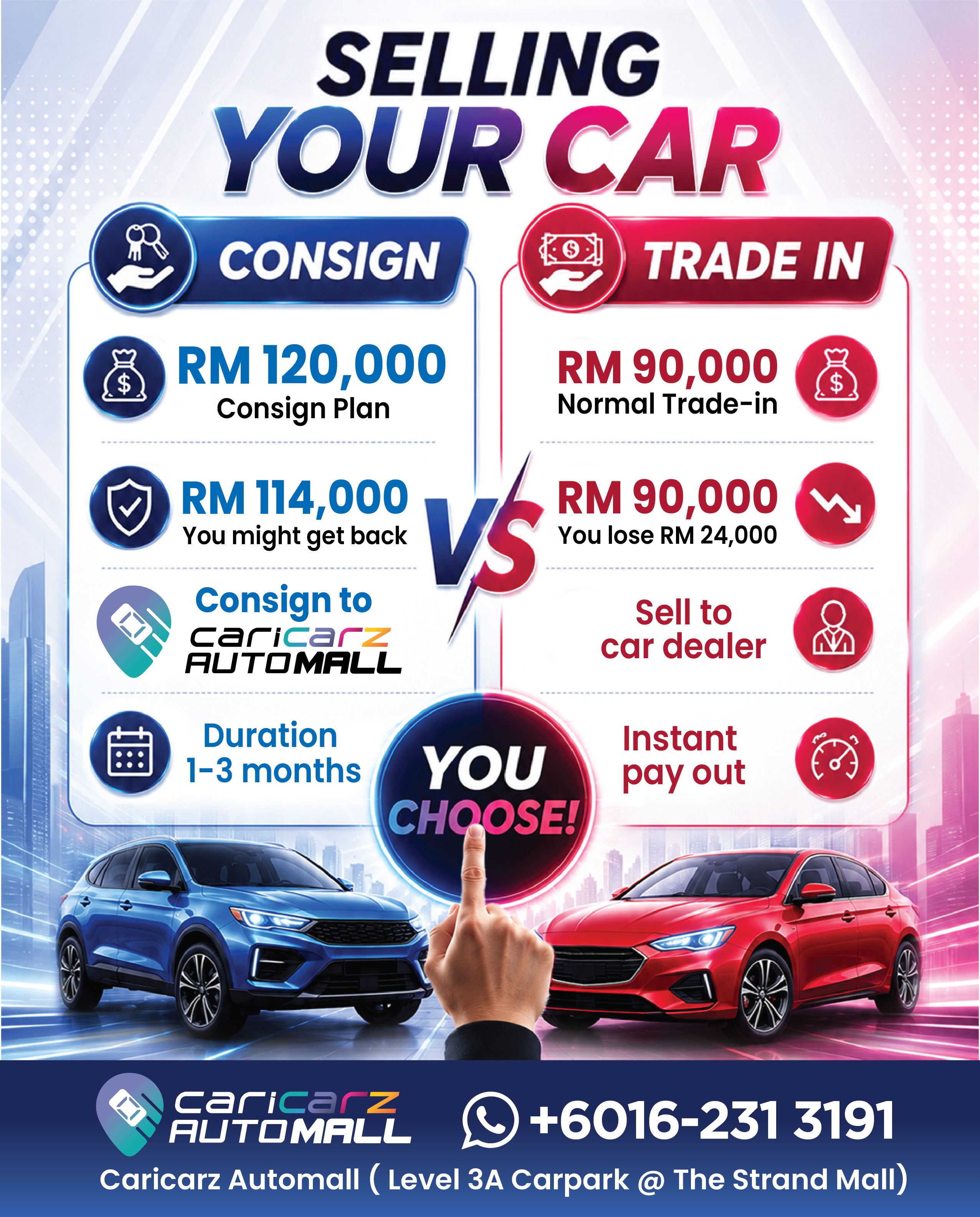
Malaysia First Used Car and EV Consignment Platform
This is the best place to sell your car at true market value. Instead of accepting low dealer trade-ins, we handle everything and connect your car directly to genuine buyers for the highest price.

Understanding CariCarzAutomall Consignment Plan

Approved 200-Check Points Inspection

7 Day Money Back Guarantee

One Year Extended Warranty

No Hidden Charge